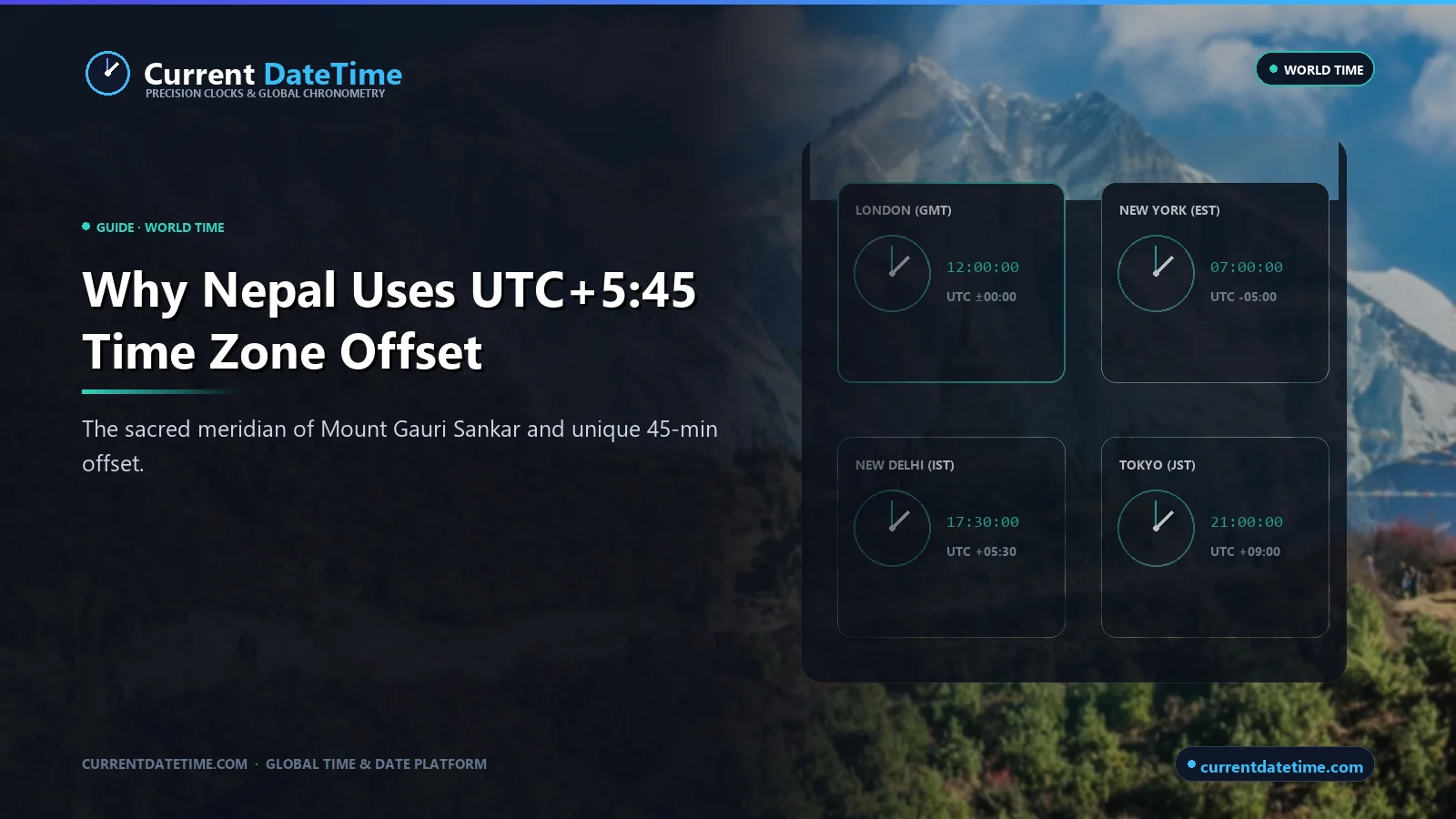
Nepal uses UTC+05:45 because its national standard time was set 5 hours and 45 minutes ahead of Coordinated Universal Time, giving the country a quarter-hour offset that better reflects Nepal's longitude than India's UTC+05:30. Nepal Time, commonly abbreviated NPT, is used throughout the country and does not currently change for Daylight Saving Time. Official Nepalese government pages identify Nepal Standard Time as UTC+05:45. (Sunawar Shimun)
The unusual part is the final 45 minutes. Most familiar time zones differ from UTC by whole hours, while India uses a half-hour offset. Nepal goes one step further:
- India:
UTC+05:30 - Nepal:
UTC+05:45
That makes Nepal 15 minutes ahead of India.
The historical IANA timezone record shows Kathmandu using a local mean-time offset of about UTC+05:41:16 before 1920, UTC+05:30 afterward, and UTC+05:45 from 1986.
For a date-specific comparison between Nepal and another country, use the CurrentDateTime Time Zone Converter.
Nepal Time at a Glance
| Question / Parameter | Official Specification |
|---|---|
| Official time | Nepal Time |
| Common abbreviation | NPT |
| UTC offset | UTC+05:45 |
| Difference from India | Nepal is 15 minutes ahead |
| Daylight Saving Time | Not currently used |
| IANA timezone | Asia/Kathmandu |
| Offset type | 45-minute offset (quarter-hour) |
| Used nationwide | Yes |
The simplest fact to remember is:
Nepal Time = UTC + 5 hours 45 minutes
\lambda_{\text{NPT}} = 5.75\text{ hours} \times 15^\circ/\text{hour} = 86.25^\circ\text{E} = 86^\circ 15' \text{E (Mount Gaurishankar)}
\Delta_{\text{LMT}} = \text{UTC}+05:45:00 - \text{UTC}+05:41:16 = +3\text{ minutes } 44\text{ seconds}
\Delta T_{\text{NPT-IST}} = (\text{UTC}+05:45) - (\text{UTC}+05:30) = +15\text{ minutes}
What Does UTC+05:45 Mean?
UTC+05:45 means Nepal's local clock is 5 hours 45 minutes ahead of UTC.
So if UTC is:
12:00 noon UTC→ Nepal time is 5:45 PM6:00 AM UTC→ Nepal time is 11:45 AM8:00 PM UTC→ Nepal time is 1:45 AM the next day
Current timezone references confirm that Nepal remains at UTC+05:45 throughout the year.
Why Does Nepal Have a 45-Minute Time Zone?
The main geographical explanation is that Nepal's longitude places its natural mean solar time between more common half-hour and whole-hour offsets.
Before modern standardization, Kathmandu's local mean time was approximately UTC+05:41:16. The IANA timezone history preserves this old local mean-time value for Kathmandu.
A modern national clock obviously does not need to preserve an awkward offset such as +05:41:16. So a cleaner quarter-hour value, UTC+05:45, provides a standardized national offset close to Nepal's geographical solar-time position.
This is a better explanation than saying Nepal simply "wanted a strange timezone."
Why Not UTC+05:30 Like India?
India uses UTC+05:30; Nepal currently uses UTC+05:45. So Nepal is 15 minutes ahead. If it is 9:00 AM in India, then it is 9:15 AM in Nepal.
Nepal previously used the same UTC+05:30 offset according to IANA's historical timezone records. The database shows Asia/Kathmandu at +05:30 until 1986, when it moved to +05:45.
The change gave Nepal an offset closer to its own longitude-based local time rather than continuing to share India's standard offset.
Did Nepal Change Its Time Zone in 1986?
According to the IANA Time Zone Database history, yes.
The historical rule for Asia/Kathmandu records:
- local mean time of approximately UTC+05:41:16 before 1920
- UTC+05:30 from 1920
- UTC+05:45 from 1986 onward.
This is an important point because some secondary websites give different years for Nepal's adoption of its modern offset. For technical and historical timezone work, I would use the IANA tz database as the stronger reference.
Why Do Some Sources Say 1956?
You may find articles stating that Nepal adopted UTC+05:45 in 1956. For example, Timeanddate currently presents a 1956 change in its historical explanation.
However, the IANA timezone database records Nepal at UTC+05:30 until 1986 and UTC+05:45 afterward.
Because these sources disagree, the safest historical wording is: Modern Nepal Time is UTC+05:45, and the IANA tz database records the transition from UTC+05:30 to UTC+05:45 in 1986. That avoids presenting a disputed date as certain.
Is Nepal's Offset Based on Mount Gaurishankar?
A widely repeated explanation links Nepal's standard-time meridian with Gaurishankar, a mountain east of Kathmandu. Several secondary timezone histories describe the chosen reference longitude as passing near Gaurishankar.
However, the strongest easily accessible primary technical source, the IANA timezone record, confirms the offset history but does not establish that symbolic explanation as the legal reason for the modern UTC+05:45 choice.
So it is better to say: Gaurishankar is commonly associated with explanations of Nepal's standard meridian, but Nepal's documented timezone history is more securely established through the actual UTC-offset records. That distinction matters for a trustworthy article.
Why Nepal's Geography Supports an Unusual Offset
Earth rotates roughly 360 degrees in 24 hours. That means approximately 15 degrees of longitude = 1 hour of solar time, and 1 degree ≈ 4 minutes.
Nepal sits east of India and west of the longitudes associated with UTC+06:00. Its geographical position therefore makes an intermediate offset unsurprising.
Instead of forcing the country onto UTC+05:30 or UTC+06:00, Nepal uses UTC+05:45.
What Longitude Corresponds to UTC+05:45?
A theoretical longitude for UTC+05:45 can be calculated as:
- 5 hours 45 minutes = 5.75 hours
- Then:
5.75 × 15° = 86.25°Eor86°15′E
So a theoretical solar-time meridian for UTC+05:45 lies near 86°15′ east longitude. This is why Nepal's offset makes geographic sense as a quarter-hour standard.
The exact legal and historical motivation should still be distinguished from the mathematical relationship.
Why Doesn't Nepal Use UTC+06:00?
UTC+06:00 would place Nepal 15 minutes farther ahead than its current standard. UTC+05:30 would place it 15 minutes farther behind. So UTC+05:45 is exactly between them.
From a longitude perspective, it provides a useful compromise. It also means Nepal has its own national time standard rather than simply adopting the same clock as a larger neighbor.
Is Nepal the Only Country With a 45-Minute Offset?
Nepal is one of the rare places using a 45-minute UTC offset. Nepal's current zone is UTC+05:45.
Other quarter-hour-based time systems exist, including the Chatham Islands' standard-time relationship at UTC+12:45.
The important point is that UTC offsets are not restricted to whole hours or half hours; they can also include 45 minutes.
Why Are 45-Minute Time Zones Allowed?
There is no global rule that requires civil time zones to be separated by exactly one hour. Governments can legally choose offsets that suit their geography, history, administration, and national time policy.
That is why the world includes offsets such as UTC+05:30, UTC+05:45, UTC+09:30, and UTC+12:45.
Time zones are human civil conventions built around astronomy, not mathematically mandatory bands.
Nepal vs India Time
Nepal: UTC+05:45 | India: UTC+05:30 | Difference: 15 minutes
| India Standard Time (IST) | Nepal Time (NPT) |
|---|---|
| 08:00 AM | 08:15 AM |
| 09:00 AM | 09:15 AM |
| 12:00 PM | 12:15 PM |
| 03:30 PM | 03:45 PM |
| 08:00 PM | 08:15 PM |
This small difference can easily be overlooked in travel or meeting planning.
Why a 15-Minute Difference Can Be More Confusing Than One Hour
People are used to calculating +1 hour, -5 hours, or +8 hours. But a 15-minute border difference is easier to forget.
For example, someone crossing from India into Nepal might assume: "Same region, probably same time." But if their phone or calendar does not update automatically, they can be 15 minutes late. That makes Nepal-India time conversion unusually easy to underestimate.
Nepal vs Pakistan Time
Pakistan uses UTC+05:00 and Nepal uses UTC+05:45. Nepal is therefore 45 minutes ahead of Pakistan.
Example: 9:00 AM Pakistan = 9:45 AM Nepal. This is another example where the difference is less than a full hour.
Nepal vs Bangladesh Time
Bangladesh uses UTC+06:00 and Nepal uses UTC+05:45. Bangladesh is 15 minutes ahead of Nepal.
So: 10:00 AM Nepal = 10:15 AM Bangladesh.
This creates an interesting regional pattern:
- Pakistan → Nepal = +45 minutes
- India → Nepal = +15 minutes
- Nepal → Bangladesh = +15 minutes
Nepal vs China Time
China uses UTC+08:00 and Nepal uses UTC+05:45. China is 2 hours 15 minutes ahead of Nepal.
So: 9:00 AM Nepal = 11:15 AM China. The quarter-hour offset means converted Chinese times often end in :15 or :45.
Nepal vs Japan Time
Japan uses UTC+09:00 and Nepal uses UTC+05:45. Japan is 3 hours 15 minutes ahead.
So: 8:00 AM Nepal = 11:15 AM Japan. Again, the 45-minute Nepal offset creates a 15-minute component in the international difference.
Nepal vs the United Kingdom
The UK changes its clock seasonally; Nepal does not.
- When the UK is on GMT: UK =
UTC+00:00, Nepal =UTC+05:45(Difference: 5 hours 45 minutes). - When the UK is on BST: UK =
UTC+01:00(Difference: 4 hours 45 minutes).
Nepal stays unchanged. The UK causes the seasonal change.
Nepal vs New York
New York also changes seasonally.
- When New York is on EDT: New York =
UTC-04:00, Nepal =UTC+05:45(Difference: 9 hours 45 minutes). - When New York is on EST: New York =
UTC-05:00(Difference: 10 hours 45 minutes).
So a meeting at 9:00 AM New York can occur at either 6:45 PM Nepal or 7:45 PM Nepal depending on the U.S. season.
Nepal vs Los Angeles
- During Pacific Daylight Time: Los Angeles =
UTC-07:00, Nepal =UTC+05:45(Difference: 12 hours 45 minutes). - During Pacific Standard Time: Los Angeles =
UTC-08:00(Difference: 13 hours 45 minutes).
A U.S.-Nepal meeting therefore often lands at a local time ending in :45 when the American time is on the hour.
Does Nepal Use Daylight Saving Time?
No. Nepal currently uses UTC+05:45 year-round.
Timeanddate's current Nepal data shows no DST changes, and current government references use the UTC+05:45 standard without a seasonal alternative.
So Nepal does not spring forward or fall back. Its own offset remains stable throughout the year.
Why Nepal's Time Difference With Other Countries Can Still Change
Nepal itself may not change clocks, but other countries do.
Suppose Nepal has a recurring call with New York. Nepal remains UTC+05:45. New York changes between UTC-05:00 and UTC-04:00. So their difference changes by one hour. This is why even countries without DST can experience changing international meeting times.
Is Nepal Time a Standard Time?
Yes. Nepal Time at UTC+05:45 is the country's standard civil-time offset. Because Nepal does not currently use DST, this standard applies year-round. There is no separate modern Nepal daylight-time offset.
What Is the IANA Time Zone for Nepal?
The IANA geographic timezone is Asia/Kathmandu.
The IANA tz database's historical entry records Kathmandu's different offsets over time, including the modern UTC+05:45 rule.
For software, Asia/Kathmandu is normally better than simply storing UTC+05:45 when historical accuracy or future rule changes matter.
Why Asia/Kathmandu Is Better for Software
A fixed offset tells software: always add 5 hours 45 minutes. A geographic timezone tells software: use the time rules associated with Nepal for the relevant date.
That distinction matters for older timestamps. IANA's historical data, for example, shows Nepal did not always use today's UTC+05:45 offset.
So a date from 1950 should not automatically be treated using the same historical rule as a modern date.
Nepal's Historical Local Mean Time
Before standardized national time, Kathmandu's local mean time was recorded at approximately UTC+05:41:16 in the IANA database.
That looks strange today because modern time zones generally use cleaner standardized offsets. But historically, local mean times often followed specific city longitudes much more closely. This is useful context for understanding why Nepal's modern quarter-hour offset is geographically plausible.
Local Mean Time vs Nepal Time
- Historical Kathmandu local mean time: about UTC+05:41:16
- Modern Nepal Time: UTC+05:45
- Difference: about 3 minutes 44 seconds
So today's national standard is relatively close to Kathmandu's historical longitude-based local time. That helps explain the geography behind the unusual 45-minute value.
Why Not Keep UTC+05:41:16?
A timezone such as UTC+05:41:16 would be unnecessarily awkward for modern national scheduling. Imagine coordinating trains, government offices, broadcasting, computers, and international flights using offsets down to individual seconds.
Standardizing to a quarter hour makes the system much easier to use while retaining a close relationship with regional solar time.
Is Nepal's Time Zone a Political Choice?
All official civil-time systems ultimately involve political or legal choices. Geography can suggest a sensible offset, but geography does not automatically force a government to adopt it.
Nepal could theoretically use UTC+05:30, UTC+05:45, UTC+06:00, or another legally selected standard. Its current UTC+05:45 setting is therefore both geographically meaningful and a national civil-time decision.
What should be avoided is asserting a specific political motive, such as "Nepal did it solely to distinguish itself from India," without strong primary historical evidence. That explanation is common online, but the documentary evidence for the precise motive is less clear than the evidence for the offset itself.
Did Nepal Choose UTC+05:45 to Be Different From India?
You will often see that claim. Nepali Times has noted the cultural significance of Nepal being 15 minutes ahead of Indian Standard Time. (Nepali Times)
However, being different from India should not be presented as the only proven reason for the offset.
A more careful explanation is:
- Nepal's geography supports an offset near UTC+05:45
- Nepal previously shared UTC+05:30 according to IANA historical records
- Nepal later adopted its own UTC+05:45 standard
- The 15-minute distinction from India has cultural and national significance
This separates documented facts from interpretation.
Does Mount Gaurishankar Determine Nepal Time Today?
No mountain physically controls modern clocks. Modern Nepal Time is a standardized UTC offset distributed through modern timekeeping systems.
The Gaurishankar explanation belongs to the historical and geographical story of the standard meridian. Today's clocks are synchronized through modern telecommunications, computing, satellite, and network time systems rather than by observing local solar noon at a mountain.
+05:45 rather than parsing whole-hour floats.
Asia/Kathmandu: Guarantee accurate historical timestamps for events before and after the 1986 transition.
Why Nepal's Offset Matters for Travelers
Travelers moving between India and Nepal should remember: Nepal is 15 minutes ahead. If your phone automatically updates, you may barely notice. But manually set watches, itineraries, and transport schedules can cause mistakes.
For example: A bus departure at 8:00 AM Nepal time is 7:45 AM India time at the same instant. A 15-minute error can be enough to miss a connection.
Why Nepal's Offset Matters for Flights
Airline systems typically handle time zones automatically, but passengers should still pay attention to whether itinerary times are local departure time, local arrival time, or UTC.
A flight between Delhi and Kathmandu crosses only a 15-minute civil-time boundary even though the actual flight takes much longer. That can make the displayed departure and arrival times look slightly unusual.
Why Nepal's Offset Matters for Remote Work
Suppose a Nepal-based employee has a call with India at 10:00 AM India; Nepal time is 10:15 AM. That is easy.
But with New York, the difference might be 9 hours 45 minutes or 10 hours 45 minutes depending on New York's seasonal clock.
For recurring international meetings, use real geographic zones rather than manually memorizing a fixed difference. The CurrentDateTime Time Zone Converter can help with date-specific comparisons.
Why Nepal Meeting Times Often End in :15 or :45
Because Nepal uses a 45-minute offset. Suppose a meeting is scheduled for 3:00 PM UTC; Nepal time is 8:45 PM. If a country uses UTC+01:00, 3:00 PM there may correspond to 7:45 PM Nepal depending on the exact relationship.
The unusual minute component naturally carries into international conversions.
UTC+05:45 in Technical Timestamps
A timestamp might look like: 2026-08-19T18:45:00+05:45.
The +05:45 tells you that the displayed local time is 5 hours 45 minutes ahead of UTC.
To convert to UTC: 18:45 - 5:45 = 13:00. So the same instant is: 2026-08-19T13:00:00Z.
This is why technical systems must support minute-level offsets rather than assuming every timezone is a whole number of hours.
Why Developers Should Never Assume Offsets Are Whole Hours
A common programming mistake is to store timezone differences only as an integer number of hours. That would work for UTC+01:00, UTC-05:00, or UTC+09:00, but fail for India (UTC+05:30), Nepal (UTC+05:45), and other fractional zones.
Timezone offsets should therefore support hours and minutes or, better, use a proper timezone library with IANA identifiers.
Does Nepal Have More Than One Official Time Zone?
No. Nepal uses one national timezone: UTC+05:45 throughout the country. Its territory is not large enough east to west to create the kind of multiple-zone administrative system seen in countries such as Russia or the United States. One national clock also simplifies domestic scheduling.
Nepal Time vs Solar Time
Official Nepal Time is standardized. Local solar time changes continuously with longitude. That means the Sun does not reach its highest point at exactly 12:00 PM everywhere in Nepal. This is normal. Time zones are regional civil standards rather than exact solar clocks for every town.
Why 45 Minutes Is Not "Wrong"
People sometimes describe Nepal as being "45 minutes off." That framing is misleading. Nepal is not incorrectly aligned with a correct whole-hour system. UTC+05:45 is a legitimate civil-time offset. Time zones do not have to be UTC+5, UTC+6, or UTC+7. Governments are free to select fractional standards. Nepal's clock is unusual, not incorrect.
Nepal Is a Good Example of How Time Zones Really Work
Nepal's timezone demonstrates several important principles at once:
- Time zones do not have to use whole hours.
- Longitude influences civil-time choices.
- Neighboring countries can differ by only 15 minutes.
- A national time standard can change historically.
- A fixed current offset is not the same as a full historical timezone.
That makes Nepal one of the clearest real-world examples for understanding UTC offsets.
Common Misconceptions About Nepal Time
Nepal Time Zone: Direct Answers
Nepal uses UTC+05:45 as its national standard time. The offset fits Nepal's geographic longitude more closely than UTC+05:30, and modern Nepal Time is standardized at 5 hours 45 minutes ahead of UTC. (Sunawar Shimun)
UTC+05:45. Nepalese government pages identify Nepal Standard Time using this offset. (Sunawar Shimun)
India uses UTC+05:30 while Nepal uses UTC+05:45. The difference is 15 minutes.
The IANA tz database records Kathmandu at UTC+05:30 from 1920 until the transition to UTC+05:45 in 1986.
The IANA Time Zone Database records the change to UTC+05:45 in 1986. Some secondary sources give a different date, so IANA is the safer technical reference for historical conversions.
No. Nepal currently stays at UTC+05:45 throughout the year.
It is commonly called Nepal Time, NPT, and uses UTC+05:45.
Asia/Kathmandu
No. Nepal is 5 hours 45 minutes ahead of UTC.
Yes. Pakistan is UTC+05:00 and Nepal is UTC+05:45.
Yes. Nepal at UTC+05:45 is 15 minutes ahead of India at UTC+05:30.
Yes, Bangladesh at UTC+06:00 is 15 minutes ahead of Nepal.
Approximately 86°15′E because 5.75 hours × 15° = 86.25°.
Civil-time offsets are policy choices. UTC+05:45 provides a quarter-hour standard closer to Nepal's longitude-based local time than either UTC+05:30 or UTC+06:00.
The Rule to Remember
The simplest explanation of why Nepal uses UTC+5:45 is:
Nepal's geography places its natural solar-time reference between common half-hour and whole-hour offsets, and the country standardized on UTC+05:45 as its national civil time.
The historical record makes that especially clear.
IANA records Kathmandu at approximately UTC+05:41:16 local mean time in its early history, then UTC+05:30, and eventually UTC+05:45.
Today:
- Nepal =
UTC+05:45 - India =
UTC+05:30 - so Nepal is: 15 minutes ahead of India.
Nepal does not currently observe Daylight Saving Time, so the offset remains stable throughout the year.
For current times across Nepal and other countries, browse the CurrentDateTime World Clock. For Nepal-India, Nepal-Pakistan, Nepal-U.S., Nepal-Europe, or other international comparisons, use the CurrentDateTime Time Zone Converter.
The safest mental shortcut is: Nepal = UTC+05:45, 15 minutes ahead of India.