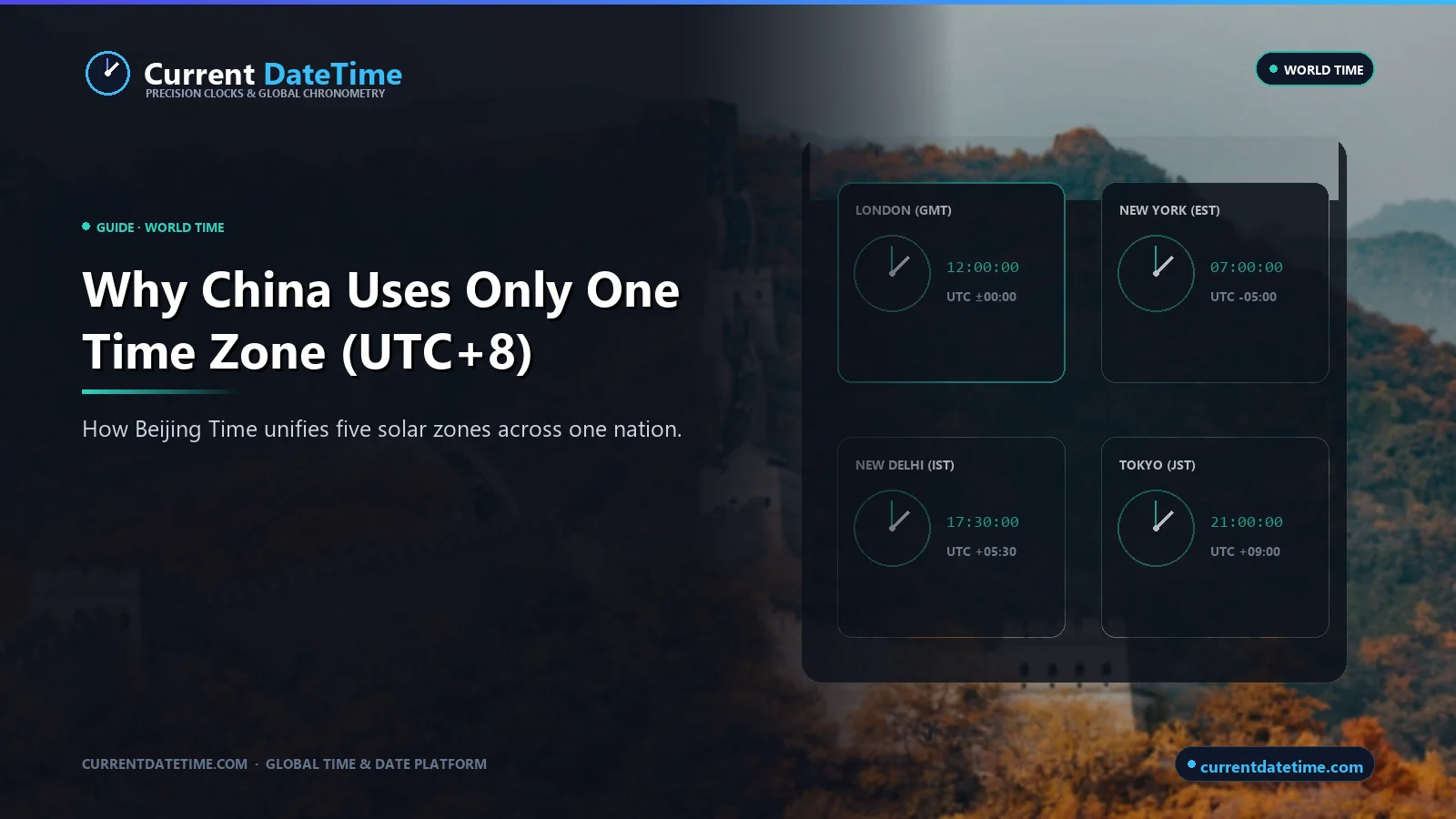
China uses one official national time zone, Beijing Time, at UTC+08:00, even though the country is geographically wide enough to cover several theoretical time-zone bands. The whole country follows the same official clock largely because China chose national time standardization over having different regional clocks. China's National Time Service Center maintains and disseminates the national standard known as Beijing Time, and official Chinese sources identify it as UTC+08:00. (english.ntsc.cas.cn)
This creates a striking contrast with countries such as the United States and Russia, which use multiple official time zones across their territory.
The result is simple administratively but unusual geographically:
Beijing and far-western China use the same official clock, even though their solar day occurs at very different times.
For current city times across China and other countries, browse the CurrentDateTime World Clock.
China’s Time Zone at a Glance
| Question | Answer |
|---|---|
| Official national time | Beijing Time |
| UTC offset | UTC+08:00 |
| Official mainland time zones | 1 |
| Daylight Saving Time currently used? | No |
| Main IANA zone used for China Standard Time | Asia/Shanghai |
| Major practical effect | Very late solar sunrise and sunset by the clock in western China |
The important distinction is: China is geographically wide enough for several solar-time zones, but it has chosen one national civil time.
\Delta \lambda = 135^\circ05'\text{E (Heilongjiang)} - 73^\circ33'\text{E (Xinjiang)} \approx 61.5^\circ \implies \frac{61.5^\circ}{15^\circ/\text{hr}} \approx 4.1\text{ Hours Solar Breadth}
T_{\text{China}} = T_{\text{UTC}} + 08:00 \quad (\text{Aligned to Reference Meridian } 120^\circ\text{E})
\Delta t_{\text{solar}} = (120^\circ - 76^\circ) \times 4\text{ min/deg} = 176\text{ minutes} = +2\text{ hrs } 56\text{ mins offset from solar noon}
What Time Zone Does China Use?
China's official national standard is commonly called: Beijing Time and it uses: UTC+08:00.
Official Chinese government and scientific sources routinely label Beijing Time as UTC+8. (Chinese Embassy in Estonia)
The Chinese Academy of Sciences' National Time Service Center is responsible for maintaining and disseminating China's national standard time. (english.ntsc.cas.cn)
So if UTC is 12:00 noon, Beijing Time is 8:00 PM throughout mainland China.
Is Beijing Time Used Only in Beijing?
No. Despite its name, Beijing Time is the national official time used across mainland China.
The National Astronomical Observatories of the Chinese Academy of Sciences states directly that the whole of China is on Beijing Time, eight hours ahead of GMT/UTC, and that China does not currently use seasonal summer-time clock changes. (National Astronomical Observatories)
That means the official clock in:
- Beijing
- Shanghai
- Guangzhou
- Chengdu
- Xi'an
- Ürümqi
- Kashgar
uses the same national UTC+08:00 reference.
Why Is China’s One Time Zone Surprising?
China stretches a very long distance from east to west.
In a simplified theoretical timezone system, Earth is divided into roughly: 15 degrees of longitude per hour because: 360 degrees ÷ 24 hours = 15 degrees.
A country as geographically wide as China could therefore reasonably be divided into several solar-time zones.
Historically, China did experiment with a multiple-zone system. The Chinese Academy of Sciences' history-of-science material describes the development of Chinese standard time from local time through coastal time and then to a five-zone time system. (IHNS English)
Modern China, however, standardized around one national clock.
Did China Always Have One Time Zone?
No. This is one of the most useful facts for understanding the current system.
China's timekeeping history went through several stages, including:
- local solar or mean time
- coastal time standards
- multiple regional standard zones
- eventually one national Beijing Time standard
Chinese Academy of Sciences historical material specifically notes that standard time in China developed through local time, standard time, Coastal Time, and five zone times before the modern system. (IHNS English)
So today's one-zone system is a policy choice, not a consequence of China always having one clock.
China Historically Had Five Standard Time Zones
During the Republic of China period, a five-zone system was developed to account for China's large east-west span.
Those historical zones represented different parts of the country with different standard offsets.
The exact implementation evolved over time and was affected by political instability and war, but the historical record is important because it shows that China's geography was once represented with several formal clock zones. (IHNS English)
The modern one-zone system replaced that fragmented approach with a national standard.
Why Did China Move Toward One National Time?
The most defensible explanation is national standardization and administrative coordination.
Using one official clock means:
- government offices share one time reference
- national television and radio schedules are simpler
- railway and airline timetables use one domestic standard
- national business coordination is easier
- official deadlines have one common interpretation
It also reinforces a single national civil-time framework across a very large country.
Time zones are political and administrative systems as well as geographic ones. China's choice illustrates that clearly.
Is the One-Zone Policy About Geography?
Not primarily. Geography would actually support multiple zones.
Western China is far enough west of Beijing that its natural daylight cycle is significantly later by the official clock.
China's one-zone system therefore prioritizes: national clock uniformity over close alignment between clock noon and local solar noon across every region. That is the central tradeoff.
Why Beijing Time Is UTC+08:00
China's national standard uses UTC+08:00.
This offset corresponds broadly to the longitude band around eastern China (120°E).
Beijing itself lies in the eastern half of the country, and many of China's most populated and economically important cities are also in the east.
Official Chinese documents and agencies consistently identify Beijing Time as UTC+8. (Chinese Embassy in Sweden)
The farther west you travel, however, the less closely the national clock aligns with the local solar day.
What Happens in Western China?
Western China experiences the most noticeable consequence of the one-zone policy.
A city in far-western Xinjiang may use the same official clock as Beijing, but sunrise can occur much later by the clock.
Imagine two places using the same official time: Beijing and Kashgar.
The Sun reaches each longitude at very different times, but both clocks still display Beijing Time.
This can make apparently ordinary clock times, such as 8:00 AM, correspond to very different levels of daylight.
Why Does the Sun Rise So Late in Xinjiang?
Because Xinjiang is far west of the longitude for which UTC+08:00 is a natural fit.
The official clock is effectively advanced relative to local solar time.
That means:
- sunrise can appear unusually late on the clock
- solar noon can occur well after 12:00 PM
- sunset can also occur unusually late
This does not mean daylight itself is shifted. Only the relationship between daylight and the official clock is unusual.
A Simple Example
Imagine two cities whose solar times differ by approximately two hours.
If both use the same official national clock, then when the eastern city's solar day feels like 8:00 AM, the western city's solar conditions may feel closer to 6:00 AM, even though both official clocks say 8:00.
That is roughly the kind of practical effect a single large national timezone can create.
Does Xinjiang Use a Different Time?
Officially, Beijing Time is the national standard.
But in Xinjiang there is also a long-established unofficial local practice known as Xinjiang Time or Ürümqi Time, generally two hours behind Beijing Time.
Academic research published by Cambridge University Press describes Beijing Time in Xinjiang as being two hours ahead of unofficial Xinjiang Time and notes that both systems can appear in local social practice. (Cambridge University Press)
So the situation is:
- Official national time: Beijing Time,
UTC+08:00 - Unofficial regional usage: Xinjiang Time,
UTC+06:00in some contexts
That distinction should be made carefully.
Is Xinjiang Time an Official Second Chinese Time Zone?
Not in the same sense as an officially recognized national zone like Eastern and Pacific Time in the United States.
China's official national standard remains Beijing Time.
Xinjiang Time is a regional informal or unofficial convention used in some communities and contexts.
That is why saying China officially has two time zones would be misleading. The official national system uses one.
Why Would People Use Xinjiang Time Informally?
It aligns the clock more closely with the local solar day.
If Beijing Time makes sunrise and daily routines appear two hours later by the clock, subtracting two hours produces times that may feel more natural locally.
For example: 10:00 AM Beijing Time corresponds to 8:00 AM Xinjiang Time.
The physical instant is identical. Only the clock label changes.
Beijing Time vs Xinjiang Time
| Beijing Time | Xinjiang Time |
|---|---|
| UTC+08:00 | UTC+06:00 |
| Official national standard | Unofficial regional convention |
| Used by national systems | Used in some Xinjiang contexts |
| 10:00 AM | 8:00 AM at the same instant |
| Maintained nationally | Local social usage |
This two-hour gap is large enough that anyone arranging a local appointment in Xinjiang should make sure both sides understand which clock is being used.
Does China Observe Daylight Saving Time?
No, not currently. China uses UTC+08:00 year-round.
The National Astronomical Observatories of the Chinese Academy of Sciences states that China does not use daylight-saving or summer-time clock changes. (National Astronomical Observatories)
So Beijing Time remains UTC+08:00 in January and UTC+08:00 in July.
That makes China's national UTC offset simpler than regions that move between standard and daylight time.
Did China Ever Use Daylight Saving Time?
Yes, China has used seasonal clock changes during periods of its history.
The modern system, however, does not currently use DST.
This distinction matters because historical timezone conversion should not simply apply today's UTC+08:00 rule to every date in China's past.
For historical calculations, software should use a maintained timezone database rather than assuming modern rules have always applied.
Why One Time Zone Makes National Scheduling Easier
Imagine a company with offices in Beijing, Shanghai, Chengdu, and Ürümqi.
Under China's official system, an internal meeting at 10:00 AM Beijing Time has one official national clock interpretation.
There is no need to ask whether the western office is two or three official zones behind.
This simplifies:
- domestic calendars
- television schedules
- government deadlines
- train timetables
- national broadcasts
- online services
Administrative simplicity is one of the strongest practical benefits of a single-zone policy.
Why Multiple Time Zones Can Be More Natural Locally
Now consider the opposite side.
If western areas used their own official zone, the local clock could align more naturally with sunrise, lunch, solar noon, sunset, and sleep patterns.
So there is a tradeoff:
- One national time zone: Better national coordination.
- Multiple geographic zones: Closer local alignment with the Sun.
China has chosen the first model.
China vs the United States
The contrast with the United States is useful.
The continental United States uses multiple major zones: Eastern, Central, Mountain, and Pacific. This keeps local clocks more closely aligned with local daylight as you move across the country.
China instead keeps UTC+08:00 across an east-west span where several zones could theoretically exist.
Neither result is dictated purely by Earth's rotation. They are different civil-time policy choices.
China vs Russia
Russia takes the multi-zone approach even further. Russia currently spans 11 official time zones.
That means eastern and western Russian cities use very different clocks.
China is also geographically enormous, but it chose one national clock.
The comparison shows how differently governments can solve the same geographic problem.
China vs India
India also uses one official national time zone despite its considerable east-west width. India Standard Time is UTC+05:30.
However, China's geographic east-west span is even more striking, so its single-zone system produces especially large differences between official clock time and solar time in the far west.
Both countries demonstrate that a large country does not have to use multiple legal time zones.
Is China Really "Five Time Zones Wide"?
You will often see the claim that China geographically spans about five theoretical time zones.
That statement is useful as an illustration, but it should be interpreted carefully.
Theoretical time zones come from approximate 15-degree longitude bands. They are not legal zones automatically assigned by nature.
The important point is: China's east-west geographic width is large enough that a conventional longitude-based system could divide the country into several zones.
Historically, China did in fact develop a five-zone standard-time system. (IHNS English) Modern China uses one.
Time Zones Are Not Determined Automatically by Longitude
China is an excellent example of this principle. Longitude explains why solar time differs, but governments decide official civil time.
A country can choose:
- several zones
- one national zone
- whole-hour offsets
- fractional offsets
- DST
- no DST
That is why time-zone maps follow political decisions as well as geography.
Is Beijing Time Based on Beijing’s Exact Solar Time?
No. Beijing Time is the national standard at UTC+08:00.
It should not be confused with the precise apparent solar time at Beijing's longitude (116.4°E, which is ~14 minutes behind 120°E).
Modern standard time uses a standardized UTC offset rather than continuously following the Sun's exact position over the capital.
Why Does IANA Use Asia/Shanghai?
This is another detail that surprises people.
For computing, the main IANA identifier representing China Standard Time is Asia/Shanghai rather than Asia/Beijing.
IANA timezone conventions use representative locations rather than simply naming every zone after a country's capital.
Historical IANA discussion confirms that Asia/Shanghai represents China Standard Time in the timezone database.
So Beijing Time is the common national civil-time name, while Asia/Shanghai is the main IANA software identifier.
Why Software Should Not Just Store "CST"
China Standard Time is sometimes abbreviated CST. But CST is highly ambiguous internationally. It can also mean North American Central Standard Time, Cuba Standard Time, and Australian Central Standard Time.
So a developer should not rely on CST to mean China. For software, use Asia/Shanghai. For a fixed instant, use UTC+08:00 or an explicit offset timestamp.
China Standard Time vs Central Standard Time
This is one of the strongest examples of abbreviation ambiguity.
- China Standard Time:
UTC+08:00 - North American Central Standard Time:
UTC-06:00 - Difference: 14 hours
So an email saying Meeting at 10 AM CST can be dangerously unclear.
Write 10:00 AM Beijing Time (UTC+08:00) if you mean China, or 10:00 AM Chicago time if you mean the North American Central region.
Beijing Time vs UTC
Beijing Time is UTC+08:00. So the formula is: Beijing Time = UTC + 8 hours.
Example: 12:00 UTC = 8:00 PM Beijing Time.
To convert Beijing Time to UTC, subtract eight hours: 10:00 AM Beijing = 2:00 AM UTC.
Beijing Time vs Pakistan
Pakistan uses UTC+05:00; China uses UTC+08:00. Difference: 3 hours. China is three hours ahead.
So 9:00 AM Pakistan = 12:00 PM Beijing Time.
This relationship remains stable under current rules because neither country currently observes seasonal daylight-saving changes.
Beijing Time vs India
India uses UTC+05:30; China uses UTC+08:00. Difference: 2 hours 30 minutes. China is ahead.
So 9:00 AM India = 11:30 AM China.
The half-hour offset in India means China-India conversions often end in :30.
Beijing Time vs Japan
Japan uses UTC+09:00; China uses UTC+08:00. Japan is 1 hour ahead.
So 10:00 AM Beijing = 11:00 AM Tokyo.
Neither country currently changes clocks seasonally, so this relationship remains stable under present rules.
Beijing Time vs New York
This relationship changes because New York observes DST.
- When New York is on EDT: New York =
UTC-04:00, China =UTC+08:00. Difference: 12 hours. - When New York is on EST: New York =
UTC-05:00. Difference: 13 hours.
China does not change. New York does. For an exact date, use the CurrentDateTime Time Zone Converter.
Beijing Time vs London
London changes seasonally.
- During GMT: London =
UTC+00:00, China =UTC+08:00. Difference: 8 hours. - During BST: London =
UTC+01:00. Difference: 7 hours.
Again, China's clock remains unchanged. The UK causes the seasonal difference.
Does One Time Zone Mean Everyone in China Follows the Same Daily Schedule?
Not necessarily. A national clock and a daily routine are two different things.
People and organizations can adjust working hours, school hours, opening times, and meal schedules to suit local daylight.
So a western city can start its day later by the official clock while still following roughly appropriate local daylight. This is one way communities adapt to a wide single-zone country.
An 8 AM Start Does Not Mean the Same Solar Time Everywhere
In eastern China, 8:00 AM Beijing Time may correspond reasonably well with the morning solar cycle.
Farther west, 8:00 AM Beijing Time can occur much earlier relative to sunrise.
So national clock uniformity does not produce national solar uniformity. This distinction is essential when looking at sunrise and sunset data.
Why Sunrise Tables Can Look Strange in Western China
Suppose a visitor checks sunrise for a western Chinese city and sees a surprisingly late clock time.
That does not necessarily mean something is wrong with the data. The Sun is following normal astronomical behavior.
The official clock is using UTC+08:00 across the country. If the location is far west of the natural central longitude for UTC+8, solar events appear later on the clock.
Does One Time Zone Save Time?
Not physically. It does not change Earth's rotation, daylight duration, travel time, or longitude.
It simply gives everyone one national civil clock. The benefit is administrative coordination; the cost is larger mismatch between official clock time and solar time in western regions.
Would Multiple Time Zones Be More Accurate?
They would align local clocks more closely with longitude and solar time. But "more accurate" depends on what you are trying to optimize.
Multiple zones may be more geographically intuitive; one national zone may be simpler administratively. Time zones are conventions designed to balance these competing needs.
Could China Change Its Time Zone System?
In principle, governments can change civil-time policy.
A country can add zones, remove zones, change UTC offset, introduce DST, or abolish DST. IANA updates timezone information when political authorities make such changes.
There is no astronomical law requiring China to remain permanently at one national timezone. Under the current system, however, Beijing Time at UTC+08:00 remains the national standard. (english.ntsc.cas.cn)
Why China’s Time Zone Matters for Travelers
If you travel within mainland China, your official clock generally does not change just because you move from east to west.
That is very different from traveling across the United States or Russia.
A flight from Shanghai to Ürümqi crosses a large longitude range, yet both endpoints use the same official Beijing Time. This simplifies ticket times but can make the daylight conditions on arrival feel surprising.
Why It Matters for International Businesses
Businesses communicating with China should use Beijing Time, China time, or UTC+08:00 rather than an ambiguous abbreviation.
For example: Meeting: 3:00 PM Beijing Time (UTC+08:00) is clearer than 3:00 PM CST because CST has several international meanings.
For recurring international meetings, use a geographic timezone such as Asia/Shanghai in calendar software.
Why It Matters for Developers
A developer might be tempted to store: China = UTC+08:00.
For many current one-time conversions, that works. But for historical calculations or location-based timezone handling, use the maintained IANA timezone database.
The current main zone is Asia/Shanghai. Historical timezone data can contain earlier rules that a fixed UTC+08:00 offset would lose.
This matters for:
- old timestamps
- historical datasets
- calendars
- legal records
- long-lived software
Should You Use Asia/Shanghai or UTC+08:00?
It depends on the task:
- One exact modern instant: UTC+08:00 may be sufficient.
- Geographic time attached to China: Use
Asia/Shanghai. - Historical local-time calculations: Use the IANA geographic zone.
- Human-facing event: Write
Beijing Time (UTC+08:00).
Asia/Shanghai (avoiding deprecated aliases like Asia/Chongqing or Asia/Harbin).
Common Misconceptions About China’s Time Zone
| Misconception | Accurate Understanding |
|---|---|
| "China is geographically only one time zone wide." | No. Its longitude span is wide enough for several theoretical zones (~60° longitude span). |
| "China has always used one time zone." | No. Historical Chinese timekeeping included a five-zone system. (IHNS English) |
| "Beijing Time applies only in Beijing." | No. It is China's national standard time across all provinces. (National Astronomical Observatories) |
| "China uses daylight saving time." | Not currently. It operates on fixed UTC+08:00 year-round. (National Astronomical Observatories) |
| "CST always means China Standard Time." | No. CST is internationally ambiguous and frequently refers to US Central Standard Time. |
| "Xinjiang officially has its own national time zone." | China's official national clock remains Beijing Time, although unofficial Xinjiang Time at UTC+06:00 is used in some local contexts. (Cambridge University Press) |
| "Sunrise happens at roughly the same clock time across China." | No. Western and eastern solar schedules differ significantly because everyone uses the same official clock. |
China Time Zone: Direct Answers
China uses one national timezone to maintain a single civil-time standard across the country, simplifying nationwide administration, communication, scheduling, and coordination.
China uses Beijing Time at UTC+08:00. Official Chinese sources identify this as the national standard. (english.ntsc.cas.cn)
Officially, yes. Mainland China follows Beijing Time nationally. (National Astronomical Observatories)
Its east-west longitude span could theoretically support several zones. Historically, China developed a five-zone standard-time system before adopting the modern unified system. (IHNS English)
Yes. Historical Chinese standard-time development included a five-zone arrangement. (IHNS English)
UTC+08:00.
No, not under the current system. (National Astronomical Observatories)
Beijing Time is the official national standard. An unofficial local convention called Xinjiang or Ürümqi Time, generally UTC+06:00, is also used in some contexts. (Cambridge University Press)
Western China lies far west of the longitude naturally associated with UTC+08:00. Since the entire country uses Beijing Time, sunrise and sunset occur unusually late by the official clock in far-western regions.
CST can be used as an abbreviation for China Standard Time, but it is ambiguous because CST has other meanings internationally. Use Beijing Time, UTC+08:00, or Asia/Shanghai when clarity matters.
IANA uses representative geographic locations for timezone identifiers. Asia/Shanghai represents China's principal national timezone rules in the tz database.
China is currently 3 hours ahead of Pakistan because China uses UTC+08:00 and Pakistan uses UTC+05:00.
China is 2 hours 30 minutes ahead of India because India uses UTC+05:30.
The Rule to Remember
The simplest explanation of why China uses one time zone is:
China is geographically wide enough for several time zones, but it uses one national clock, Beijing Time at UTC+08:00, to maintain a unified civil-time standard across the country.
Historically, China developed a five-zone system, showing that multiple zones were geographically possible. (IHNS English) Modern China instead uses one official standard, maintained and disseminated by its National Time Service Center. (english.ntsc.cas.cn)
That choice has clear benefits:
- simpler national coordination
- one official schedule
- easier domestic administration
But it also creates unusual effects:
- very late sunrise by the clock in western China
- large differences between solar noon and clock noon
- unofficial local-time practices in parts of Xinjiang
So China's system demonstrates one of the most important facts about time zones:
Geography influences time zones, but governments ultimately decide civil time.
For current times in Chinese cities, explore the CurrentDateTime World Clock. For comparisons between China and another country, use the CurrentDateTime Time Zone Converter.