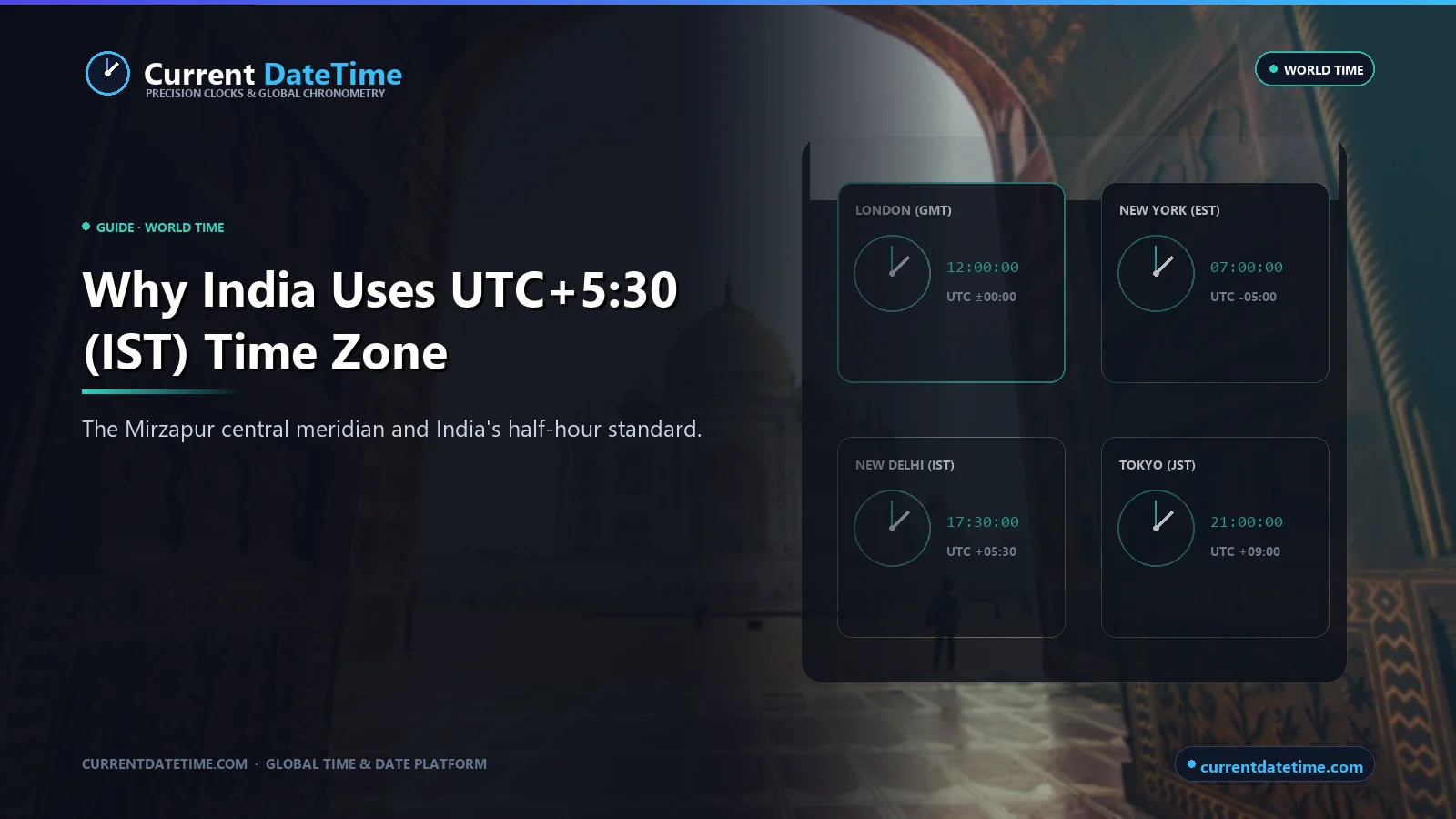
India uses UTC+05:30 because Indian Standard Time is based on the standard meridian at 82°30′ east longitude, or 82.5°E. Since Earth rotates about 15 degrees of longitude per hour, 82.5 degrees corresponds to 5 hours 30 minutes ahead of the zero-meridian time reference. Indian government educational sources identify 82°30′E as India's Standard Meridian, and CSIR-NPL, India's national time authority, maintains IST as UTC+05:30.
\omega_{\text{Earth}} = \frac{360^\circ}{24\text{ hours}} = 15^\circ/\text{hour} = 1^\circ\text{ per } 4\text{ minutes}
\lambda_{\text{IST}} = 82^\circ 30' \text{E} = 82.5^\circ \text{ East of Prime Meridian (Mirzapur)}
\Delta T_{\text{IST}} = \frac{\lambda_{\text{IST}}}{\omega_{\text{Earth}}} = \frac{82.5^\circ}{15^\circ/\text{hour}} = 5.5\text{ hours} = 5\text{h } 30\text{m} \implies \text{UTC}+05:30
The half-hour is not a mistake or a Daylight Saving Time adjustment. It is India's permanent national standard offset under the current system. CSIR-NPL states that IST is generated as UTC plus 5 hours 30 minutes.
For an exact conversion between India and another country, use the CurrentDateTime Time Zone Converter.
India’s Time Zone at a Glance
| Key Metric | Official Specification | Technical Notes |
|---|---|---|
| Official time | Indian Standard Time | Single national civil standard |
| Abbreviation | IST |
Standard civilian acronym |
| UTC offset | UTC+05:30 |
Half-hour fractional offset |
| Standard meridian | 82°30′E (82.5°E) | Mirzapur, Uttar Pradesh |
| Offset type | Half-hour offset | Permanent non-integer offset |
| Daylight Saving Time | Not currently observed | Maintained 365 days a year |
| Main IANA timezone | Asia/Kolkata |
Canonical database identifier |
| Number of official national time zones | 1 | Unified nationwide standard |
The easiest rule to remember is:
India's standard meridian is 82.5°E, and 82.5 ÷ 15 = 5.5 hours ahead of UTC.
Why Is India 5 Hours 30 Minutes Ahead of UTC?
Earth rotates approximately 360 degrees in 24 hours. So 360 ÷ 24 = 15 degrees per hour. This means every 15 degrees of longitude represents roughly one hour of solar-time difference.
India's standard meridian is 82°30′E, which is 82.5 degrees east. Now divide: 82.5 ÷ 15 = 5.5, which gives 5 hours 30 minutes. Because India lies east of the global zero-longitude reference, the offset is positive: UTC+05:30.
Indian government geography materials identify 82°30′E as the longitude used for Indian Standard Time.
Why Did India Choose 82°30′E?
India stretches a considerable distance from east to west. If every city followed its own local solar time, clocks would differ significantly across the country.
Instead, India uses one standard meridian located relatively centrally within the country's longitude range. Government educational material describes 82°30′E as India's Standard Meridian and notes that it passes through the Mirzapur region of Uttar Pradesh.
Using one centrally located standard helps create a national compromise between eastern and western solar time.
Where Does India’s Standard Meridian Pass?
The Standard Meridian of India is 82°30′E. It passes near Mirzapur, Uttar Pradesh. Government educational sources identify this longitude as the basis for Indian Standard Time.
This longitude is used as the geographic reference behind India's UTC+05:30 offset. That does not mean India's modern official time is measured by watching the Sun at Mirzapur. Modern IST is maintained using atomic-time systems by CSIR-NPL.
Who Maintains Indian Standard Time Today?
CSIR-National Physical Laboratory, or CSIR-NPL, is India's national time authority and maintains Indian Standard Time.
CSIR-NPL says its Time and Frequency Metrology Division is responsible for the realization, maintenance, and dissemination of India's national time standard. Modern IST is therefore not produced by a sundial or a local astronomical clock. It is generated using high-precision atomic clocks and linked to the international UTC system.
How Modern IST Is Generated
CSIR-NPL maintains UTC, which is India's realization of Coordinated Universal Time. It then generates IST as: UTC + 5 hours 30 minutes.
CSIR-NPL says its time scale uses cesium atomic clocks and hydrogen masers, with international traceability to UTC through the BIPM system. So the historical longitude explains why the offset is +05:30, while modern atomic timekeeping determines how accurately that official time is maintained today.
Why Doesn’t India Use UTC+5 or UTC+6?
India could theoretically have adopted a whole-hour offset, for example UTC+05:00 or UTC+06:00. But neither would represent the chosen central longitude as closely as UTC+05:30.
The 82.5°E reference falls exactly halfway between the whole-hour meridians corresponding to UTC+5 and UTC+6. That makes UTC+05:30 a natural compromise for a single national standard based on the chosen meridian.
Why Do Most Time Zones Use Whole Hours?
The theoretical global timezone system is often described in one-hour bands. Since 15 degrees of longitude ≈ 1 hour, whole-hour offsets are convenient. But countries are not required to select only whole hours. India chose a half-hour offset. Other places use 30-minute offsets or even 45-minute offsets. So UTC+05:30 is unusual compared with many zones, but it fits perfectly within the way UTC offsets work.
Is UTC+5:30 the Same as 5.30 Hours?
No. This is an important distinction. UTC+05:30 means 5 hours and 30 minutes. It does not mean 5.30 decimal hours. Five hours 30 minutes equals 5.5 decimal hours. So 82.5 ÷ 15 = 5.5 hours, which becomes 5 hours 30 minutes. This is the mathematical reason for India's offset.
What Does UTC+05:30 Mean in Practice?
It means India's clock is 5 hours 30 minutes ahead of UTC. So if UTC is 12:00 noon, India is 5:30 PM. If UTC is 6:00 AM, India is 11:30 AM. If UTC is 8:00 PM, India is 1:30 AM the next day. The half-hour means conversions often end in :30 even when the source time is on the hour.
India Time Conversion Examples
| Coordinated Universal Time (UTC) | Indian Standard Time (IST) | Day Phase & Business Context |
|---|---|---|
00:00 UTC (Midnight) | 5:30 AM IST | Early Dawn in New Delhi |
03:00 UTC | 8:30 AM IST | Morning Commute |
06:00 UTC | 11:30 AM IST | Peak Business Hours |
09:00 UTC | 2:30 PM IST | Afternoon Trading Session |
12:00 UTC (Noon) | 5:30 PM IST | Market Close & Evening |
15:00 UTC | 8:30 PM IST | Prime Time Evening |
18:00 UTC | 11:30 PM IST | Late Night |
21:00 UTC | 2:30 AM IST (Next Day) | Overnight Server Processing |
India's UTC+05:30 offset is maintained year-round under the current system.
Does India Use Daylight Saving Time?
No, India does not currently observe Daylight Saving Time. That means IST remains UTC+05:30 throughout the year.
Timeanddate's current India timezone reference confirms that India observes Indian Standard Time year-round without seasonal clock changes. So January = UTC+05:30, July = UTC+05:30, and December = UTC+05:30 under today's rules.
Why India Does Not Need IST and IDT
Countries that use DST often have two seasonal labels. For example: EST and EDT, or CET and CEST. India currently has only one official year-round offset. So there is no seasonal counterpart required for ordinary modern Indian civil time. IST remains UTC+05:30 all year.
Did India Always Use One Standard Time?
No. Before a national standard became established, different regional and local time systems were used. Historical references record time standards associated with cities such as Bombay, Calcutta, and Madras before IST became dominant nationwide. Current historical summaries note that the 82°30′E meridian was selected as a national standard in the early 20th century, while some older local standards persisted for years afterward.
That history reflects the same problem many countries faced: how do you replace many local clocks with one standard national time?
Why Standard Time Became Necessary
Before standardized clocks, local time could follow local solar noon. But that became difficult as:
- railways expanded
- telegraph communication increased
- businesses operated between cities
- national administration became more connected
India needed one agreed time that could be used consistently across railway schedules, government, communication, business, and public services. A national standard solved that coordination problem.
Why India Uses Only One Official Time Zone
India is wide enough that sunrise and sunset occur noticeably earlier in the east than in the west. Yet the country uses a single national timezone: IST, UTC+05:30.
The main practical benefit is consistency. One national time simplifies train schedules, airline schedules, government deadlines, national broadcasts, banking, business, digital systems, and meetings between Indian cities. Everyone uses the same official clock.
How Wide Is India From East to West?
India spans enough longitude that local solar time differs significantly between its eastern and western extremes. Current timezone references note that India's geographic east-west extent produces close to a two-hour solar-time difference between parts of the country. Yet official clocks remain synchronized to IST. That creates an important difference between solar time and official civil time.
Why Sunrise Is Earlier in Northeast India
Northeastern India lies far east of the IST standard meridian. Because Earth rotates from west to east, eastern locations experience sunrise and solar noon earlier than western locations. But their official clocks still use UTC+05:30, just like Mumbai, Delhi, or Gujarat. As a result, sunrise can occur surprisingly early by the clock in northeastern India.
Why Sunset Can Also Be Early in the Northeast
The same geometry affects sunset. If the Sun rises earlier relative to IST, it also tends to set earlier by the official clock. This can mean:
- daylight begins very early
- evening darkness arrives earlier by the clock
- working hours may not align perfectly with the local solar day
This is one reason India's one-time-zone system is periodically debated.
Why Western India Feels Different
Western India lies west of the standard meridian. Its solar day therefore occurs later relative to IST than in the northeast. So two cities can share 8:00 AM IST while the Sun is much higher in the eastern city than in the western city. The clock is the same. The solar conditions are not.
Has India Considered More Than One Time Zone?
Yes, the idea of giving eastern or northeastern India a different timezone has been discussed periodically. Arguments usually focus on the large east-west solar-time difference and whether a second zone could better align work and daylight in northeastern India. However, India continues to maintain one official national standard at UTC+05:30. CSIR-NPL remains responsible for maintaining and disseminating that standard. Any change would require an official policy decision rather than being determined automatically by geography.
Why Not Give Northeast India UTC+06:30?
A separate eastern zone could theoretically align local clocks more closely with sunrise and sunset. But adding another official zone would also create new complications. For example domestic train schedules, airline schedules, government coordination, national broadcasts, digital systems, meetings, and interstate travel would need to distinguish between two Indian local times. A one-zone system favors administrative simplicity. A multi-zone system could improve solar alignment. The question is ultimately a policy tradeoff.
India vs Neighboring Time Zones
| Neighboring Country | Standard Offset | Time Relative to India | Example (When India is 12:00 Noon) |
|---|---|---|---|
| Pakistan | UTC+05:00 | India is 30 minutes ahead | 11:30 AM in Islamabad |
| Nepal | UTC+05:45 |
Nepal is 15 minutes ahead | 12:15 PM in Kathmandu |
| Bangladesh | UTC+06:00 |
Bangladesh is 30 minutes ahead | 12:30 PM in Dhaka |
| Sri Lanka | UTC+05:30 |
Same Time (0 min difference) | 12:00 Noon in Colombo |
| China | UTC+08:00 |
China is 2 hours 30 minutes ahead | 02:30 PM in Beijing |
India vs China
India and China both use one main national official time despite large east-west geographic spans. China uses UTC+08:00 and India uses UTC+05:30. The major difference is that India's chosen offset is a half hour because its standard meridian is 82°30′E. China's national standard uses a whole-hour UTC+08:00 offset. Both countries show that national time zones are government choices rather than automatic longitude divisions.
India vs Pakistan
Pakistan uses UTC+05:00 and India uses UTC+05:30. So India is 30 minutes ahead of Pakistan under current rules. Example: 9:00 AM Pakistan = 9:30 AM India. This half-hour difference can surprise travelers and international meeting participants.
India vs Nepal
Nepal uses UTC+05:45 and India uses UTC+05:30. So Nepal is 15 minutes ahead of India. Example: 10:00 AM India = 10:15 AM Nepal. This is one of the clearest examples showing that neighboring countries do not need to differ by one full hour.
India vs Bangladesh
Bangladesh uses UTC+06:00 and India uses UTC+05:30. So Bangladesh is 30 minutes ahead of India. Example: 4:00 PM India = 4:30 PM Bangladesh. Again, the half-hour nature of IST creates a distinctive regional pattern.
India vs Sri Lanka
India and Sri Lanka currently share the same UTC+05:30 offset. That means their local clocks align under current rules. However, sharing an offset does not necessarily mean two countries have identical historical timezone rules. For historical or software calculations, geographic timezone data is still useful.
India vs the United Kingdom
The difference between India and the UK changes because the UK changes clocks seasonally. When the UK is on GMT: India = UTC+05:30, UK = UTC+00:00 (Difference: 5 hours 30 minutes). When the UK is on BST: UK = UTC+01:00 (Difference: 4 hours 30 minutes). India's offset did not move. The UK changed.
India vs New York
New York changes between standard and daylight time. During EDT: New York = UTC-04:00, India = UTC+05:30 (Difference: 9 hours 30 minutes). During EST: New York = UTC-05:00, India = UTC+05:30 (Difference: 10 hours 30 minutes). This is why an India-U.S. recurring meeting may move by one hour in India even though India itself does not observe DST.
India vs California
During Pacific Daylight Time: California = UTC-07:00, India = UTC+05:30 (Difference: 12 hours 30 minutes). During Pacific Standard Time: California = UTC-08:00, India = UTC+05:30 (Difference: 13 hours 30 minutes). The half-hour means California-India meeting conversions nearly always include a :30 difference when starting from a full-hour local time.
Why India-U.S. Meetings Often Use Half-Hour Times
Suppose a meeting is 9:00 AM New York. During EDT: India is 9 hours 30 minutes ahead. So 9:00 AM New York = 6:30 PM India. That :30 is not caused by DST. It comes from India's permanent UTC+05:30 offset. DST only changes the whole-hour portion of the difference.
Why India Time Is Easy to Recognize in Global Schedules
Because IST uses a half-hour offset, converted times frequently end in :30. For example: 3:00 PM UTC = 8:30 PM India, 9:00 AM New York during EDT = 6:30 PM India, and 12:00 PM London during GMT = 5:30 PM India. This makes India's time easy to spot in multinational schedules.
Is IST the Same as UTC+5.5?
Mathematically yes: 5.5 hours equals 5 hours + 0.5 hour, and 0.5 hour = 30 minutes. So UTC+5.5 = UTC+05:30. But formal timezone notation normally uses UTC+05:30 rather than UTC+5.5.
Why UTC+05:30 Is Better Than GMT+5:30
You may still see GMT+5:30 in casual use. For modern technical and international scheduling, UTC+05:30 is generally clearer because UTC is the modern global reference used for civil-time offsets. CSIR-NPL explicitly defines IST in relation to UTC, not as a modern technical derivation from GMT.
What Is the IANA Time Zone for India?
For modern software, India's principal IANA geographic timezone is Asia/Kolkata. A geographic timezone is preferable to simply storing UTC+05:30 when historical local-time rules matter. For present-day recurring schedules, both currently produce the same year-round offset, but geographic timezone identifiers are generally more future-proof and historically informative.
Why Asia/Kolkata Is Better for Software
A fixed value UTC+05:30 tells you only the numerical offset. Asia/Kolkata represents India's geographic timezone rules. That can matter for:
- historical dates
- rule changes
- calendar systems
- programming libraries
- databases
A government can change time policy. A geographic timezone can be updated to reflect that change.
Modern IST Is Much More Precise Than Its Longitude Origin
IST began as a civil-time standard based on longitude. Modern IST is an atomic-time standard maintained with extremely high precision. CSIR-NPL states that its time authority uses a bank of cesium clocks and hydrogen masers and maintains traceability to international UTC at nanosecond-level precision.
So there are two useful ways to understand IST: Why is it UTC+05:30? Because of the 82°30′E standard meridian. How is it maintained today? Through atomic timekeeping linked to UTC.
India Is Strengthening National IST Dissemination
India has also been strengthening the domestic infrastructure used to distribute its national time reference. CSIR-NPL materials describe work to disseminate IST securely and accurately to government, industry, telecommunications, financial systems, and other critical sectors.
This highlights how national time is no longer just about clocks on walls. Precise synchronized time is essential for stock exchanges, banking, telecom networks, power grids, cybersecurity, digital records, and transportation.
Why Accurate IST Matters for Banking
Digital transactions need reliable timestamps. Imagine two financial systems recording transactions using slightly different clocks. That can create problems with ordering transactions, dispute resolution, fraud analysis, and audit logs. A traceable national time reference helps ensure that systems agree on when an event occurred. This is one reason CSIR-NPL's time dissemination work extends far beyond ordinary consumer clocks.
Why Accurate IST Matters for Telecommunications
Modern networks depend on precise timing. Telecommunications infrastructure can require accurate synchronization for network coordination, data transfer, system monitoring, and infrastructure security. IST dissemination therefore has a technical role that goes far beyond the familiar UTC+05:30 displayed on a phone.
Indian Standard Time: Direct Answers
Because India's standard meridian is 82°30′E. Dividing 82.5 degrees by 15 degrees per hour gives 5.5 hours, or 5 hours 30 minutes, ahead of UTC.
The 30 minutes come from the longitude of India's selected Standard Meridian at 82.5°E.
82°30′E, passing near Mirzapur in Uttar Pradesh.
UTC+05:30. CSIR-NPL officially maintains IST at this relationship to UTC.
No. India currently stays on IST throughout the year.
Yes. Five and a half hours equals five hours 30 minutes.
Yes, under current rules. India is UTC+05:30 and Pakistan is UTC+05:00.
Yes. Nepal at UTC+05:45 is 15 minutes ahead of India.
One national standard simplifies administration, transport, communication, business, and digital systems across the country.
Northeastern India lies far east of the IST standard meridian, so its solar day occurs earlier relative to the national clock.
CSIR-National Physical Laboratory is India's national time authority and maintains and disseminates IST.
Modern IST is maintained using cesium atomic clocks and hydrogen masers at CSIR-NPL and is traceable to international UTC.
The Rule to Remember
The simplest explanation of why India uses UTC+5:30 is mathematical:
India uses that single standard across the country and currently does not observe Daylight Saving Time.
The geographical choice explains why the offset contains an unusual half hour. Modern atomic timekeeping at CSIR-NPL ensures that the national standard itself is maintained with extremely high precision.
For current times in Indian cities, browse the CurrentDateTime World Clock. For India-U.S., India-Europe, India-Pakistan, or other international comparisons, use the CurrentDateTime Time Zone Converter.